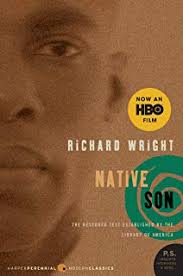
Over the summer, well more accurately the last two weeks, I read the novel Native Son. Do I regret this decision? A little bit but overall I learned a lot and enjoyed experiencing a piece of literature outside of my comfort zone. This story follows a 20 year old black man living in Chicago in the 1930s who finds himself an accidental murderer of a young white girl. It tracks his emotional struggles and realizations about life. While it shows a deep analysis of Bigger’s life, it more broadly explores and reveals the harmful effects of racial separation on society as a whole.
An element in the novel that struck me as incredibly interesting was the word blind that was used frequently in various ways and circumstances. One of these meanings was the obvious Mrs. Dalton, who was literally blind. Bigger described her as “a tall, thin, white woman, walking silently, her hands lifted delicately in the air… she seemed to him like a ghost” and as a “white blur” (Wright 46). Her blindness was known to him, but he repeated the fact over and over again as if to convince himself that she was helpless and ignorant. When he refers to her as a blur or as a ghost it represents how she is faded and unreal to him in a sense. Her blindness is a way of escape for him at first, but later on it is realized that her disability is simply that and her vision is clear in different ways, and that is what he fears most.
After the murder, Bigger wakes up full of excitement and new realizations. He looks around at the people in his life and sees how blind they are to life, him, and the world in general. Seeing his family in a new light, he thought “they needed a certain picture of the world; there was one way of living they preferred above all others; and they were blind to what did not fit. They did not want to see what others were doing if that doing did not feed their own desires” (Wright 106). This insight into his family and what they wanted out of life made them blind to all the world had to offer. It also broke down a crucial part of society, where people pick and choose what to see in order to keep themselves comfortable. Because he did not do such and was aware of the cycle of blindness, “he could see while others were blind, then he could get what he wanted and never be caught at it” (Wright 107). He used the blindness of society to gain power and understand the racism he faced in his life. This motif also reveals Bigger’s reasoning for his actions following the crime. As he believed all were unseeing, he could make the best out of his situation by earning more money. If only he knew that the smoke would clear, and his crimes would be seen in their entirety.

 coffee & contemplation
I am proud of you embracing reading something outside of your comfort zone and doing so with recognition of the motif of blindness.
LikeLike